Most families I sit down with have health insurance. They’ve got a card in their wallet, they know roughly what their deductible is, and they assume that if something bad happens, they’re covered.
Then something bad happens, and they find out what “covered” actually means.
Health insurance pays the hospital. It does not pay the electric bill while you’re in that hospital. It does not cover the paycheck you’re not earning. It does not pay for the gas back and forth, the meals in the cafeteria, the childcare while you’re at the bedside, or the deductible you have to clear before your coverage does much of anything.
Those costs land on the family. And they land at the exact moment the family has the least ability to deal with them.
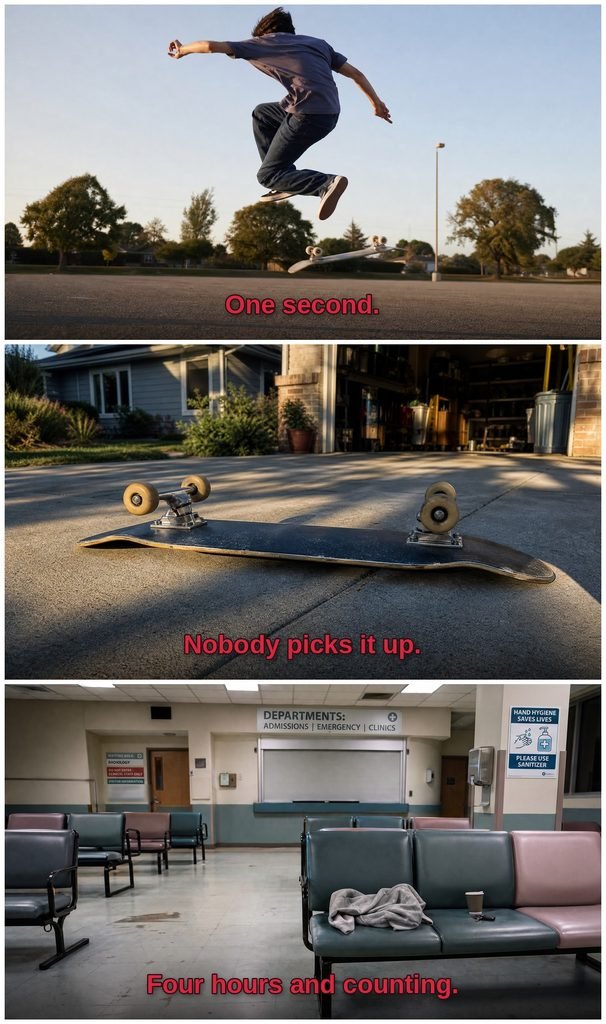
That gap is what an accident policy is built for.
What accident insurance actually is
The accident policy I write for families is an accident-only supplemental policy. Three words in that sentence do a lot of work, so let me unpack them.
Accident-only. It responds to accidental injuries. It’s not health insurance, and it’s not a replacement for health insurance. It’s a specific tool for a specific problem.
Supplemental. It pays in addition to whatever coverage you already have. There’s no primary/secondary sorting, no coordination of benefits, no subtracting what your health plan already paid. If your health insurance covers the hospital, this still pays. You get the benefits you signed up for.
Pays you. The benefit is cash, and it goes to you, not to a provider. Nobody tells you what it’s for. Put it toward the deductible if that’s the pressure point. Put it toward the mortgage if that’s the pressure point. That’s your call, and when you’re three days into something you didn’t see coming, being able to make that call yourself matters more than you’d think.
What triggers a benefit
I want to walk these in the order you’re most likely to use them, not the order a brochure would list them.
An emergency room visit
This is the one that comes up in ordinary life. The policy pays a benefit for an ER visit resulting from an accidental injury, when you’re treated within 72 hours of the injury.
Think about what actually sends people to the ER. A kid comes off a skateboard and the wrist is sitting at a wrong angle. Somebody lands badly on a trampoline. A cut while cooking that turns out to be deeper than it looked. A fall off a ladder cleaning out the gutters. A rolled ankle in a rec league game on a Tuesday night. A nail gun or a box cutter on a Saturday project that got away from you.
None of these are catastrophes. All of them generate a bill, and that bill arrives whether it was convenient or not.
The 72-hour window matters, and here’s why I bring it up. A lot of people put off going to the emergency room because they’re doing math in their head about what it’ll cost. They wait to see if it settles down overnight. That delay is the real harm — it’s bad for the injury and it can put you outside the window where a claim would have worked. If you’re hurt in an accident, get seen.
A night in the hospital
The policy pays a benefit for each night you’re admitted, when the stay is related to an accident.
This is the fall that turns out to be a fracture and they keep you two nights to set it properly. Or the car wreck where nothing’s broken, but they hold you overnight for observation on a head injury and you go home the next afternoon feeling foolish about the whole thing.
You still missed two days of work. The bill still came.
Time in intensive care
A higher benefit applies to time spent in the ICU.
Nobody plans for this one. It’s the serious wreck, the fall from real height, the thing that turns an ordinary Tuesday into the worst week of your life. And it’s the week when a family has the least capacity to think about money and the most reason to have to.
Accidental death and dismemberment
Scheduled benefits for loss of life, limb, or sight resulting from an accident.
I’ll be plain about this one, because “dismemberment” is a word that lets people keep it at arm’s length. If you work with your hands — trades, warehouse, kitchen, anything with equipment — losing a hand isn’t only an injury. It’s the end of the way you earn. The medical side gets handled. The other side is what this is for.
It covers your kids too
Most parents don’t buy accident coverage thinking about themselves. They buy it because they’ve watched a nine-year-old take a running start at something.
Kids fall off things. That’s the job description. They fall off bikes and skateboards and monkey bars and the back of the couch, and most of the time they get up and keep going, and sometimes you spend your evening in a waiting room instead. Adding children to the coverage is usually the least expensive part of the whole conversation, and for a lot of families it’s the part that actually gets used.
If you’ve got kids in sports, that goes double. Not because the sport is dangerous, but because more hours of running full speed at other kids means more chances.
It can’t be canceled on you
The policy I use is guaranteed renewable. As long as the premiums are paid on time, the company cannot cancel it. Not after a claim, not because of your age, not because your health changed.
That’s not a small thing, and it’s a fair question to ask about any policy you’re considering: what happens if I actually use this? With this one, the answer is that you keep it.
Who this is really for
Anyone whose household would feel it if one paycheck stopped for two weeks.
That’s most working families, and it’s especially true for single-income households, where there’s no second earner to absorb the shock. If your budget already has no slack in it, an unexpected two-week disruption isn’t an inconvenience — it’s the thing that puts you behind on everything else for a year.
It’s also worth thinking about for anyone who does physical work and anyone who spends a lot of time on the road. Not because those people are careless, but because more exposure means more chances, and accidents don’t care how careful you are.
What it isn’t
I’d rather you hear this from me than find out later.
This is not health insurance. It won’t pay your doctor, it won’t cover routine care, and it won’t do anything for an illness. It responds to accidents, and that’s the whole design. Anything that isn’t accidental — an illness, a condition, a surgery you scheduled — falls outside it.
It’s also not a life insurance policy. The death benefit only applies to accidental death. If you need life insurance, you need life insurance, and that’s a separate conversation we should have.
Benefit amounts, exact terms, exclusions, and availability vary. What I’ve described here is the shape of the coverage, not the contract. Before you buy anything, you should see the actual numbers for the plan you’d be getting, in your state, in writing. I’ll walk you through that line by line.
The part I can’t put in a brochure
The families who are glad they have this are almost never the families who thought they’d need it.
They’re the ones who were healthy, careful, and busy. Who took a call they almost didn’t take, spent twenty minutes on it, and then didn’t think about it again for months. And then something happened that nobody could have planned for, and in the middle of the worst week of their lives, one thing was already handled.
That’s the entire value of this. Not the payout. The fact that on the day it matters, it’s already done.
Want to know what this would look like for your family? I’ll go through the actual benefit schedule with you, in plain language, and you can decide from there. No pressure and no obligation — if it’s not a fit, I’ll tell you.
Call (925) 201-5204 or book a time that works for you.
Christopher M. Anderson, licensed life and health insurance agent. CA License #0M28817 · NPN 18753649. This is an accident-only policy. It is not a substitute for health insurance and does not provide comprehensive medical coverage. Benefit amounts, terms, conditions, exclusions, and availability vary. Complete details should be obtained from the agent or the issuing company.